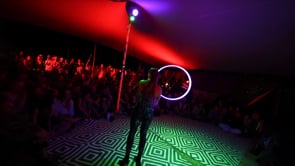
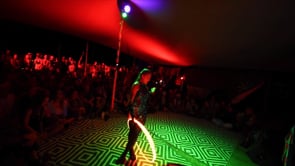
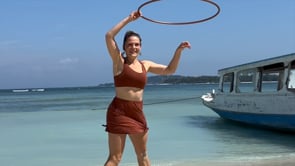
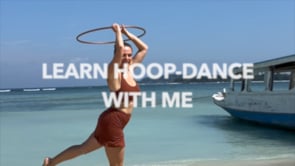





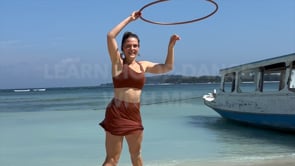
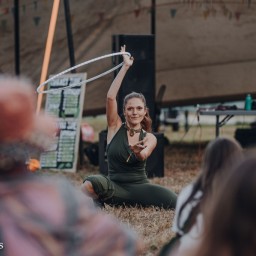
An introduction to single hoop dance, sharing the teacher’s personal hoop journey and what hooping means to her. It frames hoop dance as an expressive practice and briefly mentions differences between heavier fitness hoops and lighter dance hoops.
An overview of hoop dance as a creative movement practice with a hula hoop, combining varied tricks and dance influences into personal flow and expression. It distinguishes hoop dance from fitness hooping and notes options like different hoop sizes, materials, and using one or multiple hoops.
Overview of the hoop course structure and progression, from introduction and foundations to theory, basic tricks, and later combinations. It outlines what each chapter contains, including topics like hoop history, grips, and broad trick categories.
An overview of hoop history, from ancient hoop play in Egypt and Greece to modern hula hoop culture. It also highlights the sacred Native American hoop dance tradition and notes its distinct cultural meaning compared with contemporary recreational hooping.
An overview of common hoop grips, including up (hammer) and down grips, inside and outside grips, and two arm-supported variations: the cradle grip with the hoop resting on the forearm, and the chicken grip with the arm passing through the hoop.
An overview of on-body and off-body hooping in hula hoop, defining on-body tricks performed on different body parts and off-body tricks done around the body. It also notes common hoop size tendencies for each style and introduces transitions as links between categories.
An overview of hoop movement planes, focusing on the difference between horizontal (parallel to the floor) and vertical (upright) positioning. The lesson explains how common hoop tricks fit into each plane and how planes describe where the hoop is in space.
An overview of transitions in hooping as connecting movements between trick categories. It describes how transitions link on-body and off-body hooping and help switch between vertical and horizontal planes, with examples such as spiral up/down, weave tap, and hinge.
An overview of breaks in hoop dance: intentionally interrupting the hoop’s motion to redirect it. The concept is shown as a practical and stylistic tool for changing direction, creating accents, and adding rhythmic variation in both on-body and off-body movement.
An overview of hoop isolations, where the hoop appears to float or stay fixed in space while rotating. It references common one-handed isolations and introduces variations such as circular/centered, linear isolations along different planes, and isolations combined with ghosting.
An overview of hoop tosses and catches, focusing on throwing the hoop and catching it cleanly. Covers basic upward tosses and introduces common variations in how the hoop is released and received, including examples like the pizza toss.
An overview of hoop roll movements, where the hoop travels and rolls across different parts of the body. Examples include rolls over the arms, chest, neck, back, and thigh, focusing on the general idea of body-based roll variations.
An overview of hoop folds, focusing on folding the hoop around the arm, including the classic arm fold. The lesson also references connecting folds with other movements, such as pairing a fold with a downward escalator.
An overview of hoop balance tricks, focusing on balancing the hoop on different parts of the body. Common examples include steady balances on the palm of the hand or on the head, introducing balance as a core movement concept in hoop dance.
An overview of free-hand placement and movement in hoop dance, especially while focusing on a main trick like waist hooping. It explores simple options such as mirroring or contrasting the hoop’s path, shaping inside the hoop space, and drawing soft lines in the air.
Body movement ideas to support hooping, including moving the shoulders, chest, and hips with the hoop’s rhythm. It also covers adding simple turns, changing levels by bending or reaching, using gaze direction, and mixing active movement with brief stillness.
Waist hooping with added full-body movement, including upper-body and hip engagement, simple turns, and level changes. The lesson also touches on using gaze direction and stillness to vary rhythm and contrast while the hoop stays in waist rotation.
An overview of waist breaks in hooping, focusing on using the waist and body to interrupt or change the hoop’s rotation around the midsection. Emphasis is on adding whole-body movement and rhythm while keeping the break clear and controlled.
An overview of saving a hoop during hoop dance by keeping the body involved, not just the hands. It highlights simple full-body options that support control, such as shoulder and hip motion, slow turns, level changes, and changing where you look.